
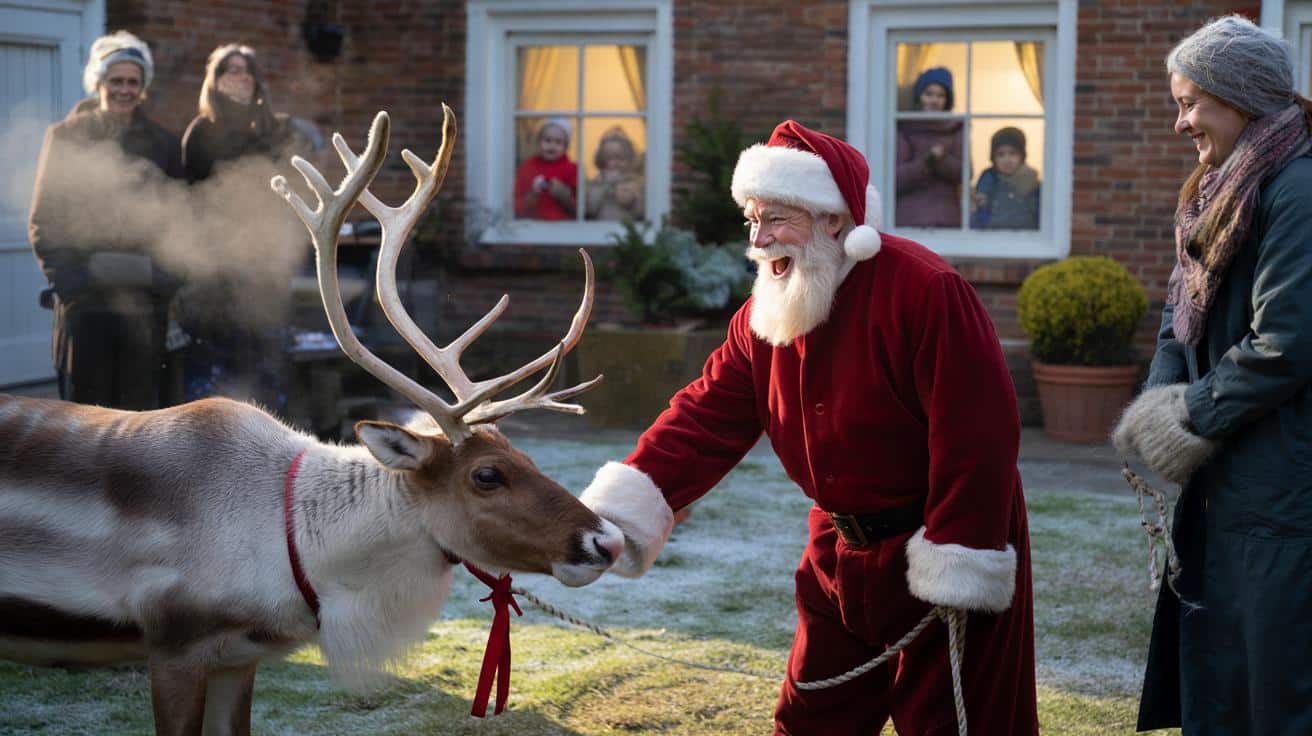
It was a small thing in a tough place: a breath of winter air, a hush of hooves on cold ground, the sweet smell of hay and handlers’ woollen gloves. Staff leaned out of doorways, patients propped in windows, families drifted from the lounge to the lawn with mugs that steamed in the December light.
The reindeer paused, heads tilting, antlers casting gentle shadows across the brick. A child pressed her mittened hand to the glass; a grandfather lifted his phone, then simply put it down to look. Santa waved, and his laugh rolled across the hedges like a warm scarf. *For a minute, the clinical world softened around the edges.*
It felt like a scene you stumble upon and carry with you. This wasn’t about spectacle so much as breathing space. He looked younger.
A winter visit that lifts the room
In the hospice courtyard, the world slows to the pace of a reindeer’s breath. The handlers stand calmly, the bells are soft, and people come forward in little waves, drawn by curiosity and memory. **Santa beamed like a man who’d just heard the first sleigh bell of his life.**
At St Helena Hospice in Colchester, the visit unfolded like a whispered story. Eileen, 74, tilted her cap and said the velvet nose felt “like warm suede” as she held out a little cone of lichen. A nurse laughed when one reindeer tried to nibble the ribbon on Santa’s sleeve. The magic wasn’t loud; it was contagious.
There’s something reliable about rituals that arrive on time. Reindeer are not cartoons in this light; they are steady animals with a snow-country gaze, and they bring the outside in. The sight, the smell, the gentle clatter of hooves gives people a route back to earlier Decembers. In palliative care, that kind of remembering is a balm.
How to bottle a moment like this (without breaking it)
If you’re thinking, can we do this where we are, the answer sits in the details. Start with licensed reindeer providers who visit care settings, then pick a short window and a quiet corner. Keep it tactile yet safe: a low rope, hand gel, light-touch ground rules, and a plan for people who would rather watch from the window than join the crowd.
Let Santa be a gentle host, not a compère. Build a simple flow: handlers arrive, reindeer settle, a small group steps forward, and the rest watch at ease. Let’s be honest: nobody wants a timetable at a moment like this. Fewer props, more warmth. **Small, well-planned moments beat big, chaotic spectacles.**
People remember how they felt. That’s the north star here.
“I came to cheer them up,” Santa said, wiping his eyes with a gloved hand, “and they ended up cheering me.”
- Choose a sheltered space with easy wheelchair access.
- Keep it short—twenty to forty minutes is plenty.
- Offer a viewing option from indoors for those who need it.
- Have warm drinks ready; the ritual matters as much as the reindeer.
- Invite families if possible—memory-making works best in company.
Why the bells echo after the van has gone
We’ve all had that moment when something tiny shifts the weight of a long day. The reindeer visit did that. It gave permission to smile without an explanation and to swap the language of charts for the language of stories. **The magic is ordinary, which is why it works.**
For staff who carry heavy schedules, a living slice of winter breaks the loop of corridor-light and handover notes. For patients and families, it places a clear, bright bead on a thread of days: “the afternoon the reindeer came.” These are the markers people hold when the calendar turns fuzzy. They are sturdy in the mind and kind on the heart.
Santa left the courtyard standing a little straighter, red suit dotted with hay, beard scented with pine. He wasn’t the star so much as the friendly narrator—guiding eyes to antlers, to breath, to touch, to laughter. In that hour, the hospice didn’t escape reality; it welcomed a new scene into it. The room remembered how to feel like a home.
| Key point | Detail | Interest for the reader |
|---|---|---|
| Reindeer bring calm | Soft sounds, familiar scents, gentle pace | Shows why small sensory details matter |
| Plan lightly | Licensed handlers, short window, simple flow | Helps replicate the moment without stress |
| Rituals heal | Seasonal visits anchor memory and mood | Invites reflection on what truly comforts |
FAQ :
- Are the reindeer real?Yes. Trained, licensed animals with experienced handlers used to care settings.
- Which hospice hosted the visit?St Helena Hospice in Colchester, where community and comfort often meet in small, vivid ways.
- Is it safe to bring reindeer into a care environment?With proper licensing, infection control, and a controlled outdoor space, yes. Handlers and clinical leads plan it together.
- How can I support events like this?Donate to your local hospice, volunteer, or sponsor a visit from an ethical animal provider. Warm drinks and extra mittens go a long way too.
- Could schools or community groups try something similar?Absolutely. Keep it short, keep it kind, and work with professionals who know their animals and your audience.
On the lawn in Colchester, the reindeer blinked in the pale sun while Santa chatted with a nurse about the right way to tie a bell to a sash. It was mundane and bright, like finding a note in the pocket of an old coat. There’s a lot you can’t fix in a hospice, and everyone there knows it. What you can do is change the weather in the room—just for an hour—and let people gather around that warmth.
This is what stays when the van doors close and the hoofprints fade in the grass: the shared quiet, the surprised laughter, the way strangers become neighbours. The next time you pass a hospice garden, picture the antlers, the soft breath, the red suit with a smear of hay. Then ask yourself what small ritual might open a window where you are. The answer doesn’t need to jingle. It just needs to arrive.




What a lovely piece—small, well-planned joy in a hard place. Thank you, St Helena and the handlers; you gave people breathing space, not spectacle. More of this, please.
Genuine question: how were allergies, infection control, and noise handled? I’d hate for good intentions to backfire—details matter, esp. in a hospice enviroment.