
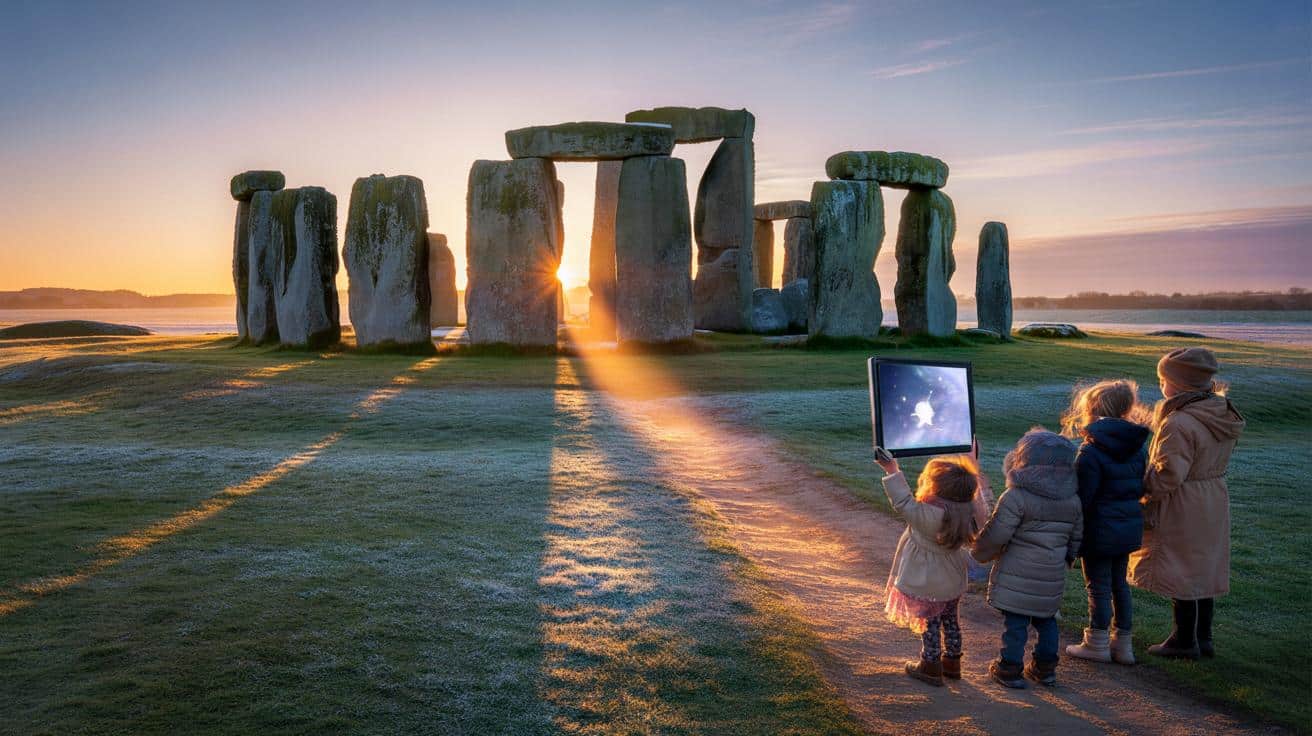
For centuries, Stonehenge has been treated like a riddle in plain sight. Now a wave of fieldwork, sky modelling, and ground-penetrating data is converging on a deceptively simple idea: the stones were set to keep human time by the Sun and the Moon — and to gather people when that time truly mattered.
A small crowd shuffled in hush, breath hanging, waiting for the moment the sun would thread the trilithon like a needle. A guide whispered about solstices. A boy pulled out a phone app and showed his dad the path of the Moon next summer, its angle strangely low. We’ve all had that moment when a place feels older than memory and yet alive to your own heartbeat.
The light sharpened, and for a second the whole circle felt like it clicked. *The stones looked like a frozen choir holding its breath.*
What if this was the point all along?
The sky’s secret schedule — and a stone-built answer
A new synthesis from archaeologists and sky-watchers is gaining traction on the plain. **New modelling points to Stonehenge as a dual solar–lunar timekeeper.** Not a clock with hands, but a landscape instrument anchoring turning points in the year and in a rarer lunar rhythm. The result is disarmingly human: a monument for knowing when to gather, when to feast, when to mourn, and when to start again.
The evidence threads across the site like chalk paths. At Durrington Walls, pig bones cluster around midwinter, their ages suggesting cold-season slaughter. Isotopes in those bones trace travellers from Wales, the Midlands, even the far north. The Avenue—the ceremonial route from the River Avon—lines up with the summer solstice sunrise and winter solstice sunset like a lit fuse. In fresh surveys, sightlines through the sarsen gaps snap to the Moon at its most extreme swing, a drama called the major lunar standstill that peaks every 18.6 years.
Here’s the logic. The solstice axis gives the year its spine; you can fix sowing, harvesting, and homecomings against it. The lunar standstill adds a longer drumbeat, a once-in-a-generation gathering that seals alliances and renews obligations. The Station Stones form a rectangle that appears to bracket lunar extremes, while the tall trilithons cradle the solstitial beam. Stone lasts; wood wanes. Set the cosmic metronome in sarsen, and your grandchildren still keep the beat.
How researchers pieced the pattern — and how you can see it too
The team approach has felt refreshingly practical. Field archaeologists mapped micro-alignments with millimetre GPS. Archaeoastronomers modelled the 2500 BCE sky, factoring in horizon bumps, refraction and the slow sway of Earth’s axis. Digital reconstructions tested what an eye could actually see through gaps and over lintels. Then came the field checks: back at dawn and dusk, in bad weather and good, they watched for light where the models said it should be.
If you’re heading down the A303, you can do a pared-back version yourself. Pick your day near the solstice and go early or late, when the sun sits low enough to lake across stone. Stand outside the rope and look along the Avenue’s long line. The trick is the horizon: it’s not flat, and Stonehenge was built to that real, lumpy skyline. Let’s be honest: no one tracks the Moon’s 18.6-year wobble from the back garden, but a decent sky app can sketch it for you.
**You can still read the sky from the stones today.** Watch for clean sightlines, not just photogenic ones. And don’t sweat the myth-busting; people have layered meanings here for 5,000 years.
“It’s not a telescope,” a field archaeologist told me, rubbing chalk dust off their sleeve. “It’s a stage. The show is the sky and the people are the chorus.”
- Best vantage: the Avenue for solstice lines; the north-east gap for summer sunrise.
- Lunar standstill: low Moon arcs on the southern side, rare and worth the wait.
- Timing: cold months sharpen the horizon; summer haze blurs it.
- Bring: a simple sky app, patience, and warm boots.
- Avoid: forcing alignments from photos; the circle is about lived sightlines.
Why this theory lands differently now
Archaeology has swung between neat labels—temple, cemetery, healing centre—and we’ve learned something from each. The solar–lunar calendar idea doesn’t cancel those. It stitches them. **The monument organised when people met, feasted, and remembered their dead.** A cemetery at its core in early phases? That speaks to winter gatherings, bone fires, and names said aloud while the sun turned and the Moon rehearsed its rare low bows.
There’s timing in the stones’ biographies too. Bluestones that began life in West Wales were moved, reset, and refined across decades. That patience makes more sense if you’re building for events your own lifetime might see once, if at all. The standstill becomes a promise to your children: we’ll meet again under this same wandering light.
Plenty will argue over angles and p-values, as they should. The charm of this theory is that it’s testable in the open, by anyone with eyes, a calendar, and time to stand still. That’s a democratic kind of awe.
What it changes for all of us
Stonehenge becomes less a passive relic and more a working instrument you can still learn to play. The pieces fall together: the avenue like an arrow, the wood-and-earth feasting ground at Durrington Walls as the warm-up stage, the river as backstage and front of house. The show is cyclical, communal, messy, sincere.
It also reframes the builders. These were not mystics in isolation. They were organisers. Project managers. People who could feed crowds, craft stone joints you can slide a postcard through, and hold a network together with a promise to meet when the sky said meet. That sounds like us, only with better skies.
This is a theory that invites participation. If you go this year or next, try reading the place as a schedule, not just a circle. The Sun gives you the rhythm. The Moon gives you the plot twist. Share what you see; the monument has room for more than one eye.
| Key point | Detail | Interest for the reader |
|---|---|---|
| Stonehenge tracks Sun and Moon | Alignments to solstices and the major lunar standstill appear baked into sarsen gaps and landscape lines | Explains a “why” you can witness yourself at dawn or dusk |
| A social calendar in stone | Evidence of winter feasts, long-distance travel, and ritual timings meshes with sky events | Makes sense of feasting, burials, and pilgrimages as one integrated story |
| You can test it in the field | Simple methods: horizon-aware sightlines, solstice dates, and the coming standstill arc | Turns a visit into a lived experiment, not just a photo stop |
FAQ :
- What’s the “real purpose” scientists are proposing?That Stonehenge functioned as a long-term sky instrument and social calendar, syncing gatherings to the Sun’s solstices and the Moon’s 18.6‑year standstill extremes.
- What is a major lunar standstill?It’s the peak of an 18.6‑year cycle when the Moon rises and sets at its most extreme points along the horizon, making unusually low and high arcs in the sky.
- Does this mean Stonehenge wasn’t a cemetery?No. Early Stonehenge held cremation burials. The calendar idea helps explain why remembrance and reunion clustered around predictable sky moments.
- Can I see these alignments on a visit?Yes. Solstice lines are straightforward near midsummer sunrise and midwinter sunset. The lunar standstill arcs are subtler, best appreciated over successive months when the Moon sits strikingly low or high.
- How confident are scientists about this?Confidence is growing with better surveys and modelling, yet debate isn’t going away. That’s healthy. The claim is testable in the open, which is part of its appeal.







If the alignments are so clear, why don’t we see the same precision at nearby sites? Could confirmation bias be creeping in? I’d like raw measurements, tolerences, and visibility studies across seasons—otherwise it feels neat but maybe too tidy.