
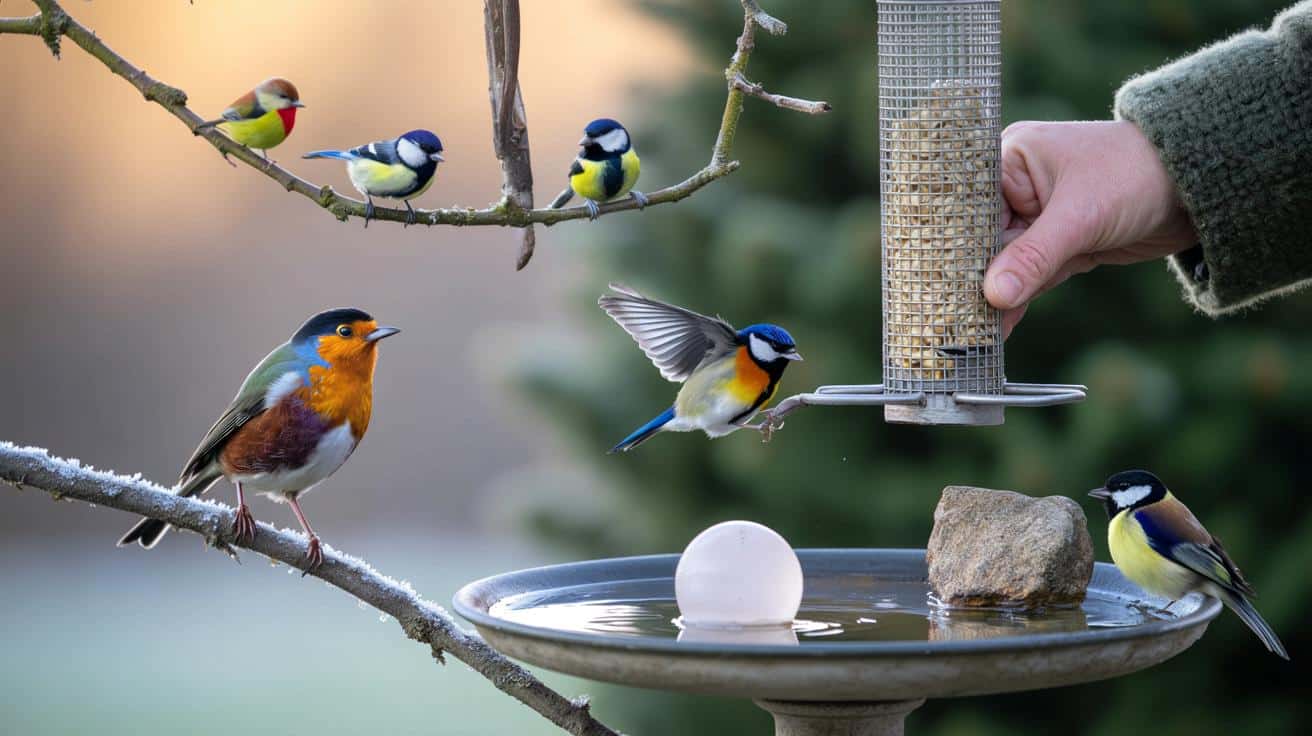
Many gardens know this little cast. The question nags at the back of the scene: why these birds, why this patch, why again and again, even through frost and sleet? The answer hides in memory, habit, and the quiet logic of survival shaped by our human routines.
The first flakes came sideways, needling the street and frosting the bin lids. I watched from the kitchen, spoon paused mid-air, as the robin hopped to where the empty feeder hung like a broken promise. A minute later the blue tits arrived, checking the hazel, then the hook, then the sill, beady eyes quick and sure. It felt like a small pact. They weren’t lost.
Why those same winter birds keep choosing your garden
Birds remember places that pay. In winter, when daylight shrinks and calories count, a reliable garden becomes a map pin in the mind. Your fence line, your apple tree, the crook where the feeder swings — all become landmarks in a private route stitched through the neighbourhood.
That robin you swear recognises you might well be holding a micro-territory that includes your lawn. Blue tits and great tits form loose winter flocks and run daily circuits, checking “known good” spots at roughly the same times. A garden that fed them well in December last year is worth a check the following December too. Routine is a survival tool.
Research on winter site fidelity shows many small birds return to consistent feeding places and roosts across seasons. They learn which windowsill spills seed, which birch hides sparrowhawks, which gutters gurgle enough to give water. The hippocampus — the brain’s memory hub — is especially important in species that cache food, like coal tits and nuthatches. They aren’t just recalling where they hid a seed; they’re building mental maps of safe, profitable space.
How to turn a cold garden into a winter waystation
Make a promise the birds can trust. Feed at roughly the same time each day, even if it’s only a little. Offer high-energy foods that don’t freeze hard: sunflower hearts, suet pellets, peanut kernels (unsalted), crushed oats. Keep at least one clean water source shallow, near shelter, and refreshed. A simple trick: float a ping-pong ball in the birdbath; a faint wobble helps slow the ice.
Think like a small bird that wants cover within a quick wingbeat. Position feeders 2–3 metres from dense shrubs so there’s an escape route, but not so close that cats can spring from undergrowth. Hang one feeder lower for robins and dunnocks, and another higher for tits and finches. We’ve all had that moment when a robin looks straight at you, as if you’re old friends. That trust is earned by predictable, calm behaviour around the feeding area. Let them see you bring the good stuff.
Avoid the classic pitfalls that blow the birds’ confidence. Bread fills bellies without feeding them well, and salted snacks dehydrate. Cheap seed mixes often pad with wheat and split peas that small garden birds can’t use, so much of it ends up mouldy on the ground. Aim for quality over quantity, and clean feeders weekly. Let’s be honest: nobody does that every single day. Better to do little and regular than grand gestures then silence.
“Birds return to places that feel safe, feed fast, and waste neither time nor body heat,” said an old gardener I met at the allotments, coat dusted with chaff. “Your garden is a pit stop on a hard winter road.”
- Place feeders 2–3 metres from cover; keep a clear view so birds can spot predators.
- Mix foods by species: sunflower hearts for tits, nyjer for goldfinches, mealworms for robins.
- Keep water shallow (3–5 cm) with a rough stone for grip; refresh often in frost.
- Skip the mesh bags that snag feet; choose smooth, well-designed feeders.
- Create roosting nooks: dense evergreens, ivy tangles, or a simple roost box out of the wind.
The quiet science behind their return — and what it tells us
Birds anchor memory to cues. In winter they key into shapes, lines, and the fixed habits of humans: a child’s trampoline, the lean of a fence panel, the jolt of a back door at 7.30. Landmark navigation blends with an internal compass set by light and magnetism, but in a small range the street map of hedges and sheds matters most. Your garden becomes a chapter in that map.
This loyalty isn’t romance; it’s economics. Every flight costs energy. Returning to a known feeder means the balance sheet tilts their way. It limits exposure to predators, trims time wasted in the open, and cuts the risk of chasing empty food sources after a cold snap. Consistency is currency, traded for survival on the thin margins of January.
Predators shape the pattern too. Sparrowhawks learn the same routes and timings, watching the rhythmic pulse of a feeding station as keenly as you do. Positioning and cover can tip the odds back. Rotate feeder spots slightly, vary heights, and break up long sightlines. *You’re editing the stage, not writing the script.* Birds will do the rest.
An open door to small wildness
There’s a wider story in a robin’s return. Gardens knit together as winter habitat only when many of us make tiny, steady gestures: a clean bath across the fence, a hedge left a little shaggy, seedheads allowed to stand. The paths birds walk in the air cross our boundaries and join us, quietly, as neighbours.
One morning in late January I saw five goldfinches swinging on the feeder, polite as commuters. The blackbird scuffed leaves near the rosemary, hunting for beetles, patient and methodical. I thought of all the human hands that keep water liquid and seed dry across the city. Little oases in the cold.
These creatures aren’t returning because they love our taste in planters. They’re coming back because our rituals — kettle, coat, scoop of seed — have made stability in a season that forgets it. Share that thought with someone. Let it land like the lightest wingbeat on a frosty branch.
| Key point | Detail | Interest for the reader |
|---|---|---|
| Winter site fidelity | Many garden birds repeat profitable routes and roosts when days are short. | Explains why the same individuals appear at the same times. |
| Garden design for safety | Feeders near cover, clear sightlines, varied heights, quality food. | Practical tweaks that increase visits and reduce danger. |
| Human routine as signal | Predictable feeding and water create reliable “map pins”. | Simple habits turn a garden into a winter waypoint. |
FAQ :
- Do birds really recognise individual gardens?They learn safe, profitable places and return to them. A garden that pays in winter becomes part of their daily circuit.
- What should I feed in a cold snap?High-energy foods: sunflower hearts, suet pellets or fat balls (no nets), peanut kernels and mealworms. Keep fresh water unfrozen.
- Is it bad to stop feeding once I start?It’s fine to miss a day or two, yet sudden long gaps in deep cold can push birds to waste energy searching. If you can, stay consistent through the hardest weeks.
- How do I keep birds safe from cats?Place feeders away from ambush cover, use baffles or spikes on fence perches near feeders, and give birds a clear view and quick escape to shrubs.
- Why do goldfinches appear in winter after ignoring my garden all summer?Seasonal need shifts. Seedheads and nyjer offer value in winter, and flock behaviour spreads news of good feeding stations fast.






Lovely piece—never knew the hippocampus played such a big role in winter site fidelity. The detail about coal tits caching and building mental maps was fascniating. Thanks for the practical tips too; ‘quality over quantity’ is a mantra I needed. I’ll move my feeder 2–3 metres from cover and clean it weekly (well… most weeks).
Genuine question: do they truly recognise my specific garden, or are they just following flock routines and copying each other’s routes? I see goldfinches only in January, then nothing till next winter. Could that just be nyjer availability in the neighborhood, rather than “memory”? Not doubting, just trying to parse causation vs correlation.