
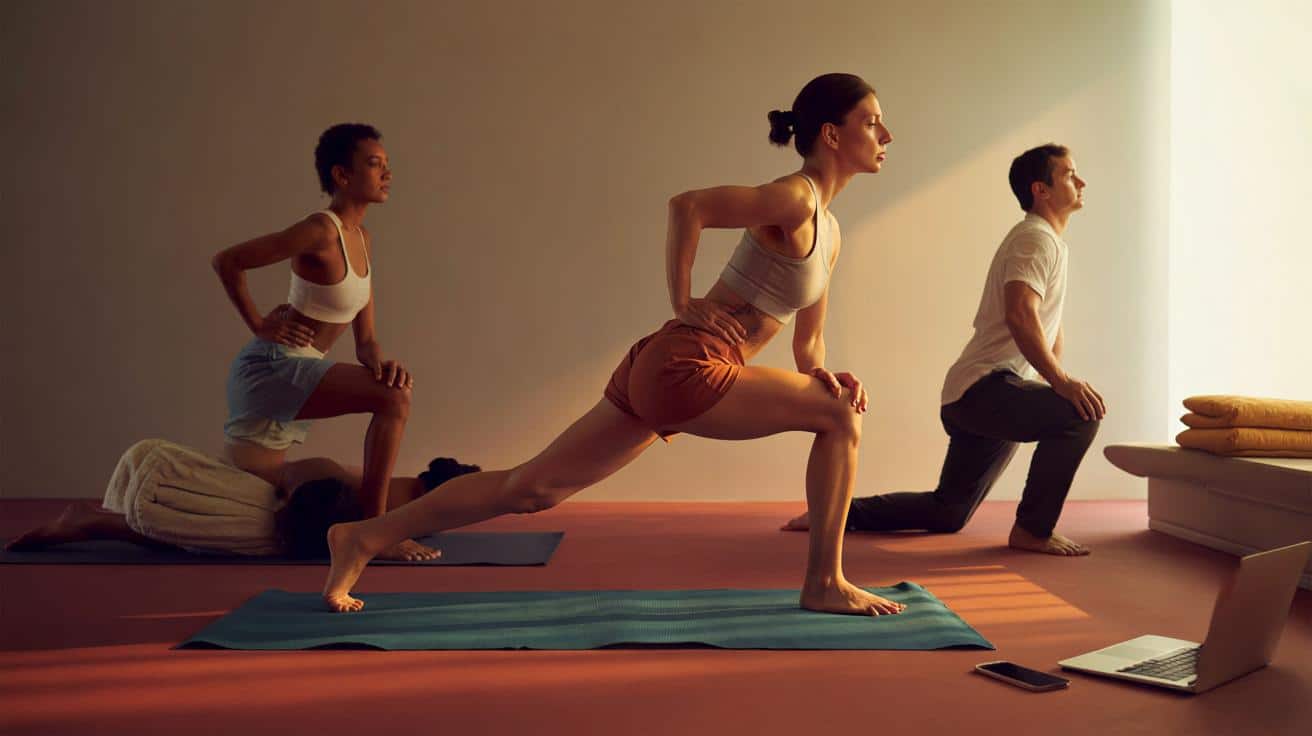
Your phone lives in your front pocket, your laptop on the table, and your hips somewhere between the two — hunched, tight, and strangely stubborn. The ache creeps in when you stand up after a long call, or when you try to stride for a train that’s already rolling in. Tight hips aren’t just an athlete’s problem; they’re the soundtrack of desk jobs, buggy pushes, and Netflix evenings.
People shuffled in, rubbing lower backs with a familiar blend of hope and resignation. The coach didn’t start with a lecture; she asked us to breathe, then raised an eyebrow at the way we sat, as if our posture had whispered a secret. Her test took thirty seconds.
Why tight hips steal your stride
Your hips are the hinge of everyday life: walking to the bus, picking up a toddler, shifting from laptop to kettle. When that hinge stiffens, everything else compensates. The lower back arches too hard, the knees twist, the feet splay out like they’re trying to escape. You don’t notice it until a small thing — tying a trainer, stepping off a curb — tugs where it shouldn’t.
Some UK surveys suggest we sit more than nine hours a day, which is a long time to hold one shape. I met Jay, a 38-year-old graphic designer, who swore his hips felt “made of concrete” after the pandemic. He wasn’t lazy; he cycled at weekends. He just lived most weekdays at a desk. After three weeks of short, targeted hip work, he stopped groaning every time he got out of the car.
Here’s the quiet truth about hips: they don’t just need length, they need rotation. The deep rotators under your glutes crave movement they rarely get, while hip flexors in the front shorten like a stubborn elastic band. The pelvis tips forward, the ribs flare, and the body’s clever workarounds turn into chronic patterns. When rotation returns, the body stops cheating. Things line up again.
The expert’s three hip-openers that actually work
Start with the **90/90 hip switch**. Sit on the floor with your front knee bent at ninety degrees and your back knee at ninety. Lean your torso over the front shin with a long spine, breathe into the stretch for 30–45 seconds, then switch to the back leg by rotating through the hips, not the lower back. Work 4–6 slow switches, keeping your sit bones heavy and your ribs quiet. *Hips are honest storytellers.*
Next, the **Couch stretch (psoas wall lunge)**. Kneel facing away from a wall, slide one shin up the wall with your knee in the corner, and bring the other foot forward into half-lunge. Tuck the tail slightly, stack ribs over pelvis, and breathe for 30–60 seconds. Common mistakes: arching the lower back, chasing depth, forgetting to breathe. Let’s be honest: nobody really does this every day. Two minutes, three times a week, will still change how you walk.
For the back of the hip, move into a **Supported figure-four or pigeon**. On your back, cross one ankle over the opposite knee and gently draw the legs in, keeping your tail heavy. Or take a supported pigeon with blankets under the hip. Hold 45–60 seconds each side, then exit slowly. Your knees should feel safe and quiet throughout.
“Mobility isn’t punishment. It’s your insurance policy for the moves you want to keep doing at 40, 60, 80,” the coach told me. “Small, regular inputs beat heroic sessions.”
- Beginner rhythm: 90/90 x 5 switches, Couch stretch 40s/side, Figure-four 45s/side.
- Breath cue: in through the nose, long sigh out, soften the jaw and belly.
- If you feel pinching in the front of the hip, reduce range and add a cushion.
- Best micro-moment: while the kettle boils or after a short walk when tissues feel warm.
Let your hips help you live, not limit you
Hips don’t loosen in a single epic Sunday session. They soften through tiny, repeatable moments that fit a real day — the ones with emails, school runs, and a queue at Pret. Try a minute of 90/90 before you put on your shoes. Take the Couch stretch after a call while your inbox refreshes. Slip in a figure-four before bed when the room has gone quiet. You’ll notice your stride lengthens, stairs feel lighter, and your lower back doesn’t start negotiations every time you stand. What happens to your day when your hips stop whispering “no” and start saying “go”?
| Key point | Detail | Interest for the reader |
|---|---|---|
| 90/90 hip switch | Rotates both hips through external and internal ranges; 4–6 slow reps with controlled breathing. | Restores the “lost” ranges that make walking, squatting, and turning feel smooth again. |
| Couch stretch / wall lunge | Targets psoas and rectus femoris; tail-tuck and rib stack prevent back compensations; 30–60 seconds per side. | Unwinds hours of sitting, helping your stride open and the pelvis find a neutral home. |
| Supported figure-four or pigeon | Releases deep glutes; use cushions to protect knees; exit as slowly as you enter. | Eases hip tension that tugs on the lower back and makes getting up feel less stiff. |
FAQ :
- How long should I hold each hip stretch?Thirty to sixty seconds per side works for most people. Two to three rounds feels like a warm bath for the hips without turning it into a marathon.
- Is it safe if I have knee pain?Keep the knee comfortable and supported, especially in pigeon or the wall lunge. If you feel sharp, localised pain in the knee, back out and switch to gentler options like the supine figure-four.
- Should I stretch before or after running?Use dynamic versions — light 90/90 switches and walking lunges — before you run. Hold the longer static stretches after, or in a different part of the day when tissues are warm.
- How often until I notice change?Three short sessions a week can shift how your hips feel within two to three weeks. Daily micro-sessions accelerate things, especially when combined with regular walking.
- Do I need a yoga mat or special gear?No. A carpet, a cushion, and a wall are enough. Props are comfort, not status — blankets and books are great improv tools.








Desk goblin here: added 90/90 switches and the couch stretch while the kettle boils, and my stride legit feels longer after 10 days. Breth cue helped a ton. Didn’t think rotation was my missing piece—turns out it was. Thanks for the no-fuss plan! 🙂