
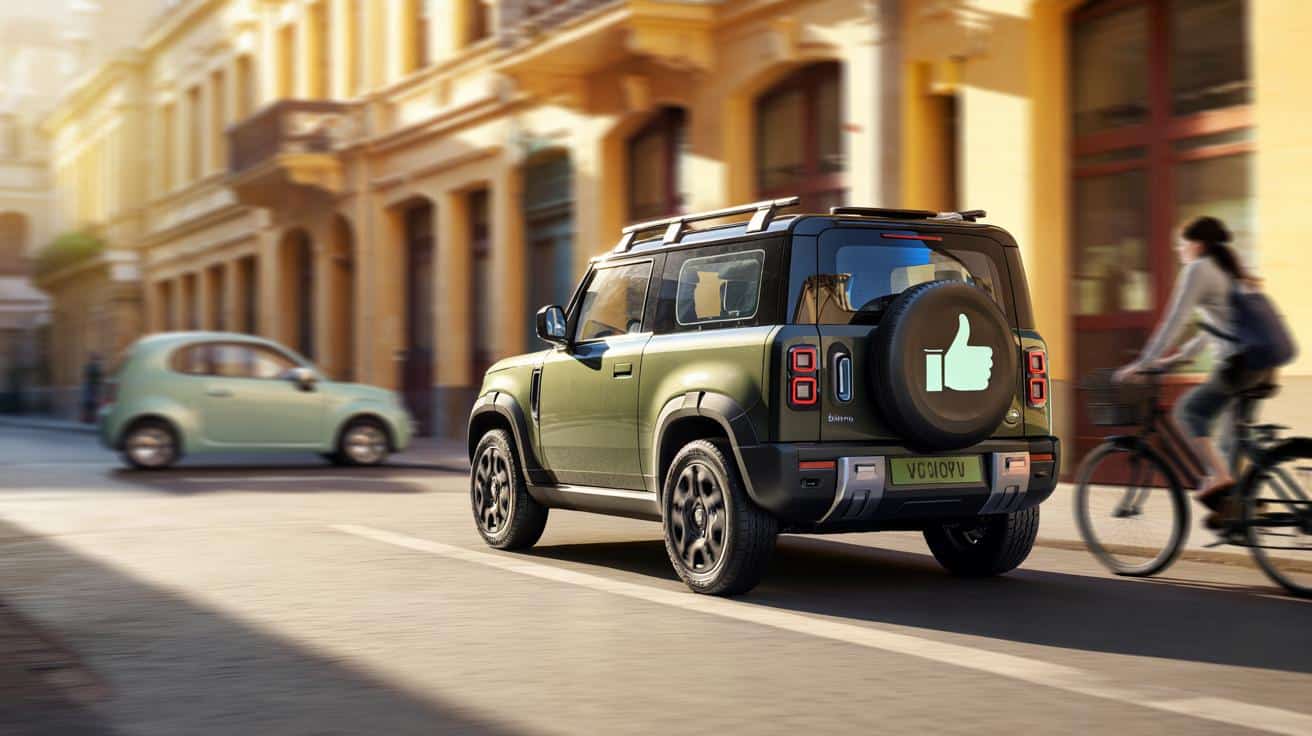
A Chinese mini SUV with chunky Land Rover vibes has quietly exploded on social feeds — and its base price undercuts a brand‑new Fiat 500. It looks like a shrunken Defender, yet it’s an electric city car with a party trick on its tailgate and a price tag that makes you blink.
Matte green, squared-off arches, roof rails, a spare wheel hump that wasn’t a spare wheel at all — more like a toy Defender scaled to city life. Two cyclists actually slowed and stared as the owner tapped a button and the tailgate screen lit up with a pixelated thumbs-up.
We chatted under the awning. He’d imported it via a specialist, he said, because he wanted something cheeky, small, electric and not boring. He called it the Baojun Yep — a Chinese EV that’s so dinky it fits nose-to-kerb on streets where SUVs never dare. Then he told me the price.
A figure smaller than the café’s monthly rent. A figure that made the Fiat 500 feel like a splurge. Strange, right?
A baby “Defender” that isn’t pretending: meet the Baojun Yep
Pull up a photo of the Baojun Yep and you’ll see it immediately — the upright bonnet, the square stance, the honest, no-flab silhouette. It wears its Land Rover energy like a thrift‑store Barbour: a nod to outdoorsy romance without the mud-caked reality. Only here, the proportions are cartoonish in the best way.
The Yep is tiny by SUV standards, about 3.4 metres long, two doors, four seats if your mates don’t mind friendly elbows. In China, early models packed a rear-mounted 50 kW electric motor and an LFP battery good for a quoted 303 km on the lenient CLTC cycle. The rear tailgate even carries a little exterior screen, a playful “Car‑Watch” for emojis and messages that kids adore and adults pretend not to.
Here’s the jolt: in its home market, the Baojun Yep launched from around 79,800 RMB — roughly under £10,000 at the time. **In sticker‑price terms, it slides under a new Fiat 500 like a limbo dancer.** That doesn’t make it a like‑for‑like rival — one is a mainstream European city car, the other a Chinese micro‑SUV aimed first at domestic streets. Yet the number plants a seed: what happens when design theatre and EV pragmatism arrive at supermini money?
Why it’s so cheap, and why that’s not the whole story
Start with scale. Baojun sits under the SAIC-GM-Wuling umbrella, a joint venture with a knack for simple, wildly popular urban EVs like the Hongguang Mini. The Yep is built to be light on parts, heavy on charm: a single motor, no ornate air suspension, a modest battery, lots of straight panels that are quick to stamp and bolt. LFP chemistry keeps costs lower and longevity higher, even if outright range isn’t headline-busting.
Then there’s the design language. It’s not a clone — think silhouette echoes rather than 1:1 tracing. No lawsuit bait, just clever proportion play: high beltline, vertical light clusters, short overhangs. That visual honesty papers over what it is mechanically: a city EV first, an adventure cosplay second. Plenty of buyers are fine with that. They want the look, the parking ease, the low running costs, the Instagram wink.
The stat that helps it click: electricity in Chinese cities can be pennies per mile when charged off-peak. One Shanghai software engineer told me he spends less on a month of commuting than his old scooter insurance. He likes that it’s rear‑drive, nips through traffic, and doesn’t reek of compromise. **This isn’t a Defender.** It’s a pocket‑friendly, urban reinterpretation — and that honesty is a big part of its appeal.
Thinking of jumping in? Here’s how to judge value vs. reality
First, separate price headlines from your real life. If you’re in the UK or Europe, the sub‑£10k number is China‑only. Imports bring shipping, VAT, testing, and compliance costs that can double the out‑the‑door figure. A smart method: write two columns — total landed cost today, and five‑year life cost. Include a conservative resale estimate. Then call three insurers before you fall in love; quotes can swing wildly on grey imports.
Next, map your actual miles. The Yep’s quoted range uses a generous domestic cycle; expect less in cold, fast, hilly conditions. Do a “week-in-the-life” test on paper: school run, commute, weekend errands, annual trips. If one or two days blow past the comfortable range, you may end up nursing the battery more than enjoying the car. Let’s be honest: nobody actually does that every day. We’ve all had that moment when the battery icon feels like a ticking timer.
Finally, sanity‑check expectations. It looks ready for a mountainside, but its talents are urban. Light trails and gravel car parks, fine. Rock crawling, no. If crash ratings and service networks matter, wait for official distribution and proper NCAP testing rather than gambling on guesswork.
“I bought it for city joy and school‑gate smiles,” said an early owner in Guangzhou. “It replaced my scooter, not my weekend car.”
- Budget beyond the sticker: shipping, tax, homologation, parts, and insurance can bite.
- Confirm charger access at home and at work before you sign anything.
- Treat off‑road styling as style; buy for what you’ll actually drive.
- Ask for written warranty terms in your language, with parts lead times.
- Check your local rules on exterior screens; fun features aren’t always legal.
The bigger picture: when design, tech, and price redraw the map
The Baojun Yep isn’t storming British showrooms tomorrow. And yet it already shifts how the market feels. A car this expressive, this neatly city‑sized, this cheap to run — it pokes a hole in the idea that small EVs must be either dull or dear. It also shows how fast Chinese brands move: iterate quickly, weaponise charm, keep the bill of materials lean.
There’s a cultural thread here too. A Land Rover silhouette once signalled farm tracks and Atlantic squalls. Now it’s a vibe, remixable for dense streets where kerb space is king and speed is the enemy. The Yep taps that vibe without apology. It invites a different sort of brag: not horsepower, but cheek. Not leather, but laughter. **Price has a way of resetting what feels “normal”.**
Will more of these pop up, legally sold and warrantied in Europe? Probably. Chinese carmakers are already tailoring export‑friendly models, and Western brands are watching the recipe: a clear look, an honest use case, a bill that doesn’t sting. Share this with the person in your group chat who swears small EVs are boring. Then ask them what a Fiat 500 should cost now that a tiny pseudo‑Defender exists.
| Key point | Detail | Interest for the reader |
|---|---|---|
| Price shock | Baojun Yep launched in China from ~79,800 RMB (under £10k equivalent at the time) | Frames the “less than a Fiat 500” claim with real numbers |
| Design vibe | Boxy, Defender‑like silhouette with playful tailgate “Car‑Watch” screen | Explains why it turns heads and lights up social feeds |
| Use case | Rear‑drive, single‑motor city EV; quoted CLTC range around 303 km | Helps decide if it fits daily life vs. adventure fantasy |
FAQ :
- What exactly is the “Chinese Land Rover‑style” SUV?The Baojun Yep, a compact electric SUV from the SAIC‑GM‑Wuling family, styled with rugged, boxy cues reminiscent of a mini Defender.
- Does it really cost less than a Fiat 500?In China, yes — base prices launched under the UK cost of a new Fiat 500. Importing to Europe changes the maths significantly.
- Can I buy one in the UK?Not officially. Some specialists can import one, but you’ll face shipping, compliance, parts, and insurance hurdles.
- Is it actually off‑road capable?It’s designed for urban use with light‑trail ability at best. Think kerbs, speed bumps, and rainy car parks, not green‑laning epics.
- What are the key specs?Early Chinese models offered a rear motor around 50 kW and an LFP battery with a quoted ~303 km CLTC range, plus that distinctive tailgate display.








Price is wild — what’s the catch? Warranty, service network, and parts?
That little “Car‑Watch” on the tailgate might be the most delightfully unnecessary feature I’ve seen all week. I don’t need it. I absolutely want it.