
Waiting rooms full of hope and clenched hands, then long car rides home in silence. Patrick Steptoe walked straight into that silence and changed the texture of it, not with slogans, but with instruments, patience, and the kind of stubborn faith that doesn’t photograph well. His research didn’t just tweak a technique. It shifted a life script. And the ripple touches you and me, whether we notice it or not.
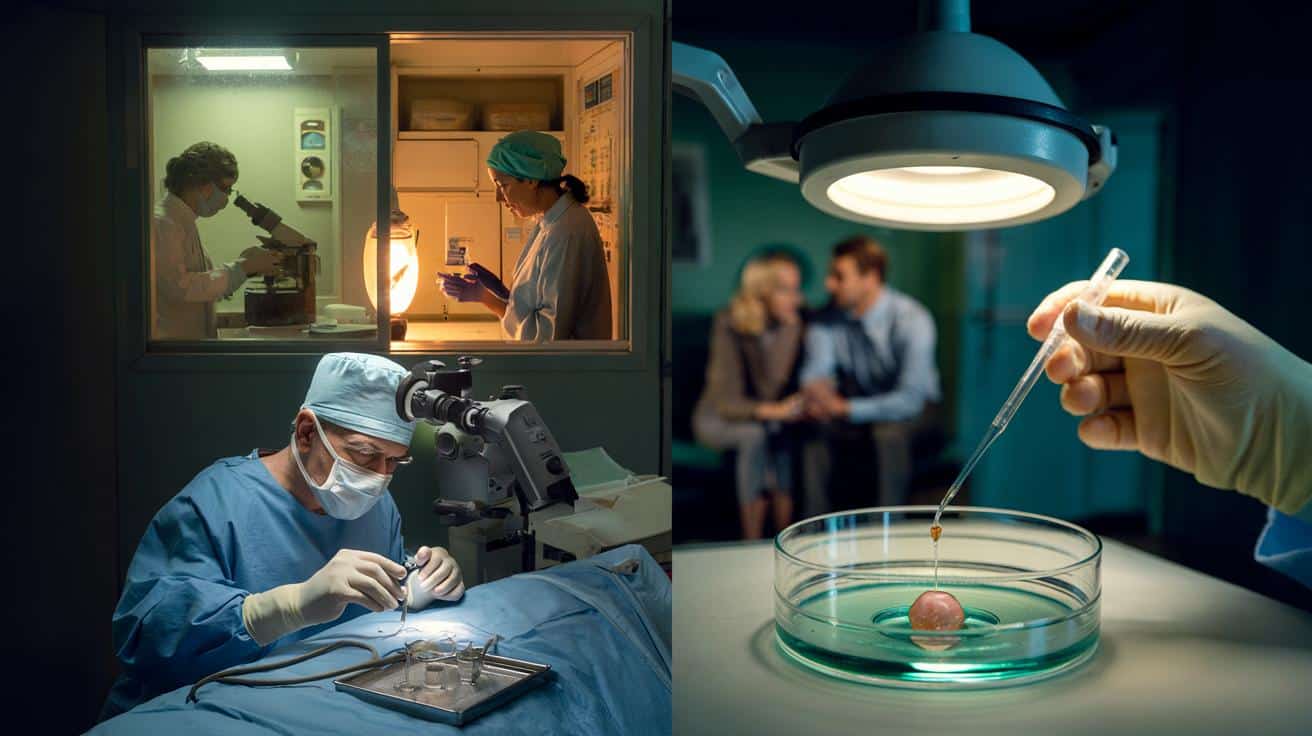
The lights in Oldham General’s corridor fizzed softly the night the future crept in. A trolley squeaked past a poster for the hospital summer raffle, and in a small theatre a measured voice asked for the laparoscope. Steptoe moved with the tidy economy of a village GP and the daring of a test pilot, while in a side room Robert Edwards checked the media and Jean Purdy watched the dishes like a hawk. It felt ordinary. It wasn’t. *It felt like a moon landing played out in a quiet ward.* At 11.47pm, something that wasn’t possible became possible. And then the world had to catch up. A simple question hovered: what do we do with possibility?
From a quiet Lancashire theatre to a global family
Patrick Steptoe didn’t look like a revolutionary. He trained as an obstetrician-gynaecologist, carried a calm manner into tense rooms, and kept his notes neat. Yet his embrace of laparoscopy — sliding a camera inside the abdomen to see and work with minimal trauma — opened a new doorway to the ovaries, and with it a path to IVF. That leap wasn’t flashy. It was practical, almost homespun, honed on long shifts and quiet Saturdays. **A theatre the size of a cupboard** was enough when courage and craft were in the room.
When Louise Brown cried for the first time in 1978, the world found a new sound to argue about. Her birth in Oldham was the first via IVF, and it arrived after years of rejection, sniggering headlines, and closed doors at funding bodies. Steptoe and Edwards scraped by, while Jean Purdy — the third pillar — kept the lab alive with a nurse’s twitchy vigilance and a scientist’s patience. Today, more than ten million babies have been born thanks to assisted reproduction. Every school photo, every birthday candle, every bone-deep yawn on a Sunday morning traces back to a small team in Lancashire. **Louise Brown’s first cry** became millions of quiet victories.
People like to imagine breakthroughs as lightning bolts. This was a kettle left to boil — countless careful increments: refining the egg retrieval, timing ovulation, stabilising embryo culture, warding off contamination. The trio had to invent a choreography between theatre and lab, seconds mattering like heartbeats. Ethics boards glowered; bishops thundered; newspapers winked. Yet the moral logic settled into something simple: reduce suffering, expand fairness, watch closely. You don’t need to worship science to see the human core here. You just need to watch a new parent hold a child and stop talking for a second.
Inside the method: small moves, big stakes
What actually happened, body to bench and back? Steptoe used laparoscopy to collect mature eggs at the right moment, shining a precise light into a dark place, moving as if the instruments were extensions of his own fingers. Edwards would meet the eggs in the lab with carefully prepared sperm, in culture media balanced like a recipe you could ruin with one careless pinch. Then came the embryos — a handful of cells that demanded warmth, calm, and time. Replacing them into the uterus looked simple. It never was.
We’ve all had that moment when the instructions sound easy until you try it yourself. IVF gets flattened into a neat line on a clinic website. Real life brings age, hormones that misbehave, hidden infections, timing that resists calendars, and emotions that don’t wait their turn. Let’s be honest: nobody actually does that every day. Even today, a single cycle can fail without anyone doing anything “wrong”. Steptoe’s lesson endures: precision matters, but kindness is part of the method too.
Science tells a story with its hands, not just its mouth. You can picture Steptoe looking through the scope, heart rate steady, the team reading each other’s breaths. That discipline — boring to watch, electric to experience — is the hidden engine of IVF’s success.
“Science is stubborn hope, turned into method.”
- Tool: the laparoscope, allowing gentle, targeted egg retrieval.
- Timing: ovulation tracked to the hour, not just the day.
- Culture: stable temperatures, clean media, unhurried observation.
- Transfer: minimal fuss, maximal focus, quiet hands.
The legacy that keeps rewriting itself
Steptoe co-founded Bourn Hall with Edwards and Purdy, building a home for a discipline that barely had a name. From there, techniques spread and diversified: ICSI for severe male-factor infertility, embryo freezing, preimplantation genetic testing, and protocols kinder to the body. Debate never vanished; it matured. Regulation in the UK grew up with the science, through the Human Fertilisation and Embryology Authority, as if the country made a social contract with the lab bench. The heart of that contract remains startlingly modest — make a painful thing less painful — and yet its consequences reach into names, family trees, and holiday gatherings. **Millions of quiet victories** tend not to trend on social media. They just grow up, borrow the car, and ask for more toast.
| Key point | Detail | Interest for the reader |
|---|---|---|
| Steptoe’s craft | Pioneered clinical laparoscopy to retrieve eggs safely | Shows how a surgical tweak unlocked a new future |
| The Oldham trio | Steptoe, Robert Edwards, and Jean Purdy formed a rare, balanced team | Explains why collaboration beats lone genius |
| Global impact | Over ten million births via assisted reproduction since 1978 | Connects one hospital’s gamble to everyday lives |
FAQ :
- Was Patrick Steptoe solely responsible for IVF?No. He was the clinical lead and laparoscopic pioneer, working hand-in-glove with scientist Robert Edwards and embryologist Jean Purdy. The breakthrough was a three‑way partnership.
- Why was IVF so controversial at the time?It challenged beliefs about conception, raised questions about embryos, and arrived before clear rules existed. The UK eventually built robust regulation to match the science.
- How many IVF babies are there today?Estimates suggest well over ten million births worldwide since 1978, with hundreds of thousands more each year as access expands.
- What made Steptoe’s technique special?His laparoscopy skills allowed precise, minimally invasive egg retrieval and tight timing, which, combined with lab excellence, lifted success from hope to reality.
- What is Bourn Hall, and why does it matter?Bourn Hall Clinic, co‑founded by Steptoe, Edwards, and Purdy, became a cradle for IVF practice and training, spreading knowledge that shaped global standards.







As an IVF dad, this hit home. The quiet discipline you describe is exactly what we felt from our team — no fireworks, just skill and kindness. Our little boy turns 3 next week; he exists because Steptoe, Edwards, and Purdy refused to give up. Thank you for honoring them. 🙏😊
Compelling history, but a question: as UK regualtion matured via the HFEA, how do we handle globlal clinics where oversight is thin? What standards should be universal for add‑ons, PGT, and data transparency so patients aren’t sold hope-as-product? Any links to outcomes registries beyond the UK/US?